VOLKSWAGEN 5GE853687 Vw Rear Trunk Hatch Emblem Badge
fits model: Mk7, Golf. make: Volkswagen. year: 2015–2020.
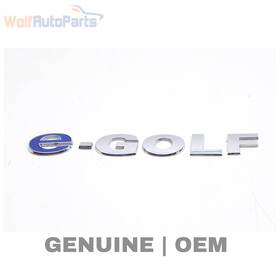
( Manufacturer Part Number: 5GE853687 ), ( Part Type: Trunk Emblem ), ( Manufacturer Warranty: 30 Day ), ( Tested: Tested, Cleaned And Inspected ), ( Placement On Vehicle: Rear ), ( Fitment Type: Direct Replacement )
Review VOLKSWAGEN Vw E golf Rear Trunk Hatch Emblem Badge fits GOLF MK7 2015–2020
The **Volkswagen 5GE853687 2015 2020 VW e-Golf (Mk7) Rear Trunk Hatch Emblem Badge** is a sleek, high-quality emblem designed specifically for the iconic **Volkswagen e-Golf**, the brand s pioneering all-electric compact hatchback that redefined urban mobility with its blend of German engineering and eco-conscious innovation. Crafted from durable, premium-grade materials, this emblem features the **distinctive Volkswagen logo a stylized four-ring crest set against a polished, chrome-plated finish**, ensuring a sharp, reflective appearance that enhances the vehicle s modern aesthetic. The badge is meticulously engineered to fit seamlessly onto the **rear hatch of the Mk7 e-Golf (2015 2020 models)**, where it serves as both a functional identifier and a subtle statement of the car s electric heritage. The **precision-cut edges and smooth contour** of the emblem ensure a flush, professional installation, complementing the e-Golf s clean, aerodynamic lines while subtly signaling its zero-emission capabilities. Whether mounted on a freshly restored classic or a meticulously maintained daily driver, this emblem elevates the vehicle s presence, reinforcing Volkswagen s legacy of craftsmanship and forward-thinking design. Ideal for enthusiasts seeking to preserve or enhance their e-Golf s originality, this badge is a testament to the model s timeless appeal and its role as a pioneer in the transition toward sustainable transportation.
### **Pros and Cons of Buying a 2015 2020 Volkswagen e-Golf (5GE853687, Rear Trunk Hatch Emblem Badge)**
#### **Pros**
1. **Electric Vehicle (EV) Technology** The e-Golf is a fully electric car, offering zero tailpipe emissions and lower operating costs compared to gasoline or diesel vehicles. It s ideal for urban driving and short to medium commutes.
2. **Good Range (for its era)** The 2015 2020 models typically come with a **38.5 kWh battery**, providing an **estimated range of 80 100 miles (WLTP/EPA)** under real-world conditions. While not as high as newer EVs, it was competitive for its time.
3. **Regenerative Braking** The e-Golf uses regenerative braking effectively, which helps extend battery life and improves efficiency, especially in stop-and-go traffic.
4. **Low Maintenance Costs** Electric vehicles have fewer moving parts than internal combustion engines, meaning less oil changes, fewer spark plugs, and reduced wear on transmission and engine components.
5. **Instant Torque & Smooth Acceleration** The electric motor delivers immediate power, resulting in quick acceleration and a quiet, smooth driving experience.
6. **Tax Incentives & Rebates** Depending on your location, you may qualify for **federal, state, or local EV incentives**, including tax credits or reduced registration fees.
7. **Compact & Maneuverable** The e-Golf is a hatchback, making it easy to park and navigate in tight urban spaces. It s also lighter than comparable gasoline cars, improving handling.
8. **Recall & Warranty Considerations** Some early e-Golf models had battery-related recalls (e.g., 2015 2016 for potential fire risks), but Volkswagen has addressed these with software updates and replacements. Check if the vehicle has been serviced.
9. **Resale Value (for EVs of its time)** While not as high as newer EVs, the e-Golf retains some value due to its popularity and the growing demand for used electric vehicles.
10. **Environmentally Friendly** If charged with renewable energy, the e-Golf produces no direct emissions, making it a greener choice than conventional cars.
---
#### **Cons**
1. **Limited Real-World Range** The **80 100 miles** of range is sufficient for daily commuting in many cases, but long trips require careful planning. Charging stops may be necessary on extended journeys.
2. **Slow Charging Speeds** The e-Golf supports **Level 1 (120V home charging, 3 5 miles per hour)** and **Level 2 (240V, 15 20 miles per hour)** charging. Fast charging (DCFC) is **not available** on these models, meaning long charging times at public stations.
3. **Battery Degradation Over Time** Like all EVs, the battery loses capacity over years of use and charging cycles. A **2015 2020 e-Golf may have lost 10 20% of its original range** due to age, depending on usage.
4. **Higher Upfront Cost (vs. Gas Cars)** While used e-Golfs are more affordable than new ones, they are still **more expensive to purchase** than comparable gasoline cars. However, this is offset by lower fuel and maintenance costs.
5. **Charging Infrastructure Limitations** If you don t have home charging, finding reliable public charging stations can be challenging, especially in rural areas.
6. **Potential Battery Replacement Cost** If the battery degrades significantly, replacement costs can be **$5,000 $10,000 **, though some extended warranties or leftover factory coverage may apply.
7. **Resale Depreciation** EVs, even used ones, tend to depreciate faster than gasoline cars due to evolving technology. The e-Golf may not hold its value as well as newer EVs.
8. **Limited Aftermarket Support** While not a dealbreaker, finding specialized EV mechanics or parts can be harder than for traditional cars.
9. **Cold Weather Impact** Battery efficiency drops in cold climates, reducing range by **20 30%** in freezing temperatures. Heating the cabin also drains battery power.
10. **Software & Infotainment Limitations** The e-Golf s infotainment system is **basic compared to modern EVs**, with a smaller touchscreen and fewer connectivity features.
---
### **Conclusion & Recommendation**
The **2015 2020 Volkswagen e-Golf (5GE853687)** is a **solid choice for someone looking for an affordable, low-maintenance electric vehicle** that fits urban or short-commute needs. It s particularly well-suited for:
- **City dwellers** who rarely drive long distances.
- **Environmentally conscious buyers** who want to reduce emissions.
- **Those who can charge at home** (or have access to reliable public charging).
- **Budget-conscious EV shoppers** who don t need the latest technology.
However, it is **not ideal** for:- **Long-distance drivers** who need frequent charging stops.
- **Buyers who prioritize fast charging** (DC fast chargers are unavailable).
- **Those in very cold climates** without proper charging infrastructure.
- **People who want cutting-edge tech** (the e-Golf s tech feels dated compared to newer EVs).
#### **Final Recommendation:**- **Buy if:** You need a **used EV for daily commuting**, can charge at home, and don t require extreme range. Ensure the battery health is checked (look for **SOH (State of Health) reports** or a pre-purchase inspection).
- **Avoid if:** You frequently drive long distances, live in an area with poor charging infrastructure, or want a more advanced EV experience.
- **Consider alternatives:** If you want a **newer EV**, look at **used Tesla Model 3, Nissan Leaf, or Chevrolet Bolt** for better range and tech. If you need a **gas car**, a **used hybrid (like a Toyota Prius)** could be a more practical backup.
**Best for:** Urban drivers who want an eco-friendly, low-cost electric car for short trips.
**Worst for:** Highway commuters or those who prioritize long-range electric driving.
Details:
Remember LEFT means the Drivers side of vehicle and RIGHT Passengers in our listings. Part Fitment and Compatibility.
specifications emblico:
- for models: Mk7, Golf
- for makes: Volkswagen
- for years: 2015-2020
- mpn: 5ge853687
- part type: Trunk Emblem
- manufacturer warranty: 30 Day
- tested: Tested, Cleaned And Inspected
- placement on vehicle: Rear
- fitment type: Direct Replacement
payments emblico:
- credit card: Discover
- other
- wallet: Apple-pay
general emblico:
- condition: Used
- Car Truck Parts Accessories > Exterior Parts Accessories > Emblems Ornaments
offer emblico:
- options: Ship-to-home
- availability: In Stock
- sold: 0
- started: May 12, 2026
- quantity: 1
returns emblico:
- paid by: Buyer
- time: 30 Days
- policy: Returns Accepted
shipping emblico:
- class: Standard, Expedited, One-day
- carrier: USPS, FedEx
- service: USPS Ground Advantage, FedEx 2Day One Rate Small Box, FedEx Standard Overnight, USPS Priority Mail Padded Flat Rate Envelope
- type: Fixed
- transit: 3-9 Days
- cost: $0.00
seller emblico:
- city: Waverly, Minnesota
- rating: 99.7%
- # reviews: 101767
Volkswagen 5GE853687 Is Similar To:
- 113 853601b Volkswagen Volkswagon-beetle-vw-bonnet Badge (38.8% similar) 25 sold as is, what you see on photos will get thank for looking. Vintage Volkswagen-beetle-vw-bonnet badge emblem part number 113853601B slug bug Germany in silver color, sold as is, please see all photos for best...(December 29th, 2017)
- 113853601a German Emblem Front Hood Vw Prong Fits Volkswagen Bug (18.3% similar) Comes with 3 retaining clips: vw number clips are usually white clear color but can be black free shipping within contiguous us states. Vw number 601A diameter 800 millimeters, tab with white plastic insert on underside...(June 17th, 2018)
- 185853679g Volkswagen Jetta Gli Badge Emblem Front Grill Genuine (32.4% similar) Genuine Gil 16V front grille badge. Excellent used condition. As pictured...(September 18th, 2018)
- 191 853 601 Cav1 Vw Vintage Volkswagen Front Grill Emblem Oem Part (31.9% similar) 75 inches across. 1980 S vw grill emblem part CAV1 original plastic chrome logo in good condition has layer of patina measures...(May 9th, 2018)
- 191853687b Volkswagen Vw Golf Gl Rear Badge Emblem Oem (51.5% similar) If your looking for a specific part and do not see it within our listing. Also take a look at our Facebook page curbside euro...(September 19th, 2018)
- 1hm853675 Volkswagen Jetta Gl Black Trunk Emblem Badge Oem Symbol Logo (43.2% similar) ...(July 30th, 2018)
- 1j5 853 601a Volkswagen Oem Vw Jetta Front Grill Emblem (37.6% similar) Volkswagen Etta front grill emblem...(January 14th, 2019)
- 1j583601ulm 1j853601-a Volkswagen Jetta Front Grille Emblem Logo Badge Oem Genuine (33.8% similar) Please match our part number with your original one. If the item was damaged on return shipping due to poor packaging, is not accepted. There is a product inspection with third party upon receiving the item. Please ship the item back in its original package...(January 31st, 2019)
- 1k0853688f739 Genuine Volkswagen Audi Vw Exclusive Badge (37.3% similar) Peel and stick, measures roughly by 5/8 please for any fitment questions. If you would like to request a quote have this product shipped outside of the contiguous us, please. Genuine vw Audi - exclusive badge 1K0853688F739 mfg: straight out of the European parts catalog is this very unique emblem. ...(September 13th, 2018)
- 1k9-853-687-a-739 Volkswagen Jetta Emblem Genuine Oem Oe (32.8% similar) Shipping information: residential ground packaging within the 48 contiguous USA is quoted...(November 30th, 2018)
- 1k9853630a Volkswagen Jetta Trunk Lid Logo Emblem Oem (44.3% similar) I recommend to used a new double side tape reapplied the back in order install. Please compare part number and pictures very carefully. Most of the emblems will need some sort adhesive to install this it vehicle. See all pictures for details. It will come exactly as you see on pictures...(April 15th, 2018)