MITSUBISHI 7415A213 Name Plate Badge
fits model: Lancer. make: Mitsubishi. year: 2008–2015.
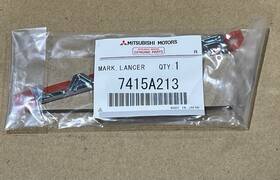
( Manufacturer Part Number: 7415A213 ), ( Fitment Type: Direct Replacement ), ( Color: Silver ), ( Vintage Part: No ), ( Placement On Vehicle: Rear ), ( California Prop 65 Warning: May Cause Cancer And Reproductive Harm. See Www.p65warnings.ca.gov For More Info. ), ( Type: Chrome Name Plate ), ( Year: 2008 2010 2011 2012 2013 2014 2015 ), ( Model.: Evolution Mr Touring ), ( Theme: Names ), ( Finish: Chrome ), ( Country Of Origin: Japan )
Review MITSUBISHI Genuine Chrome Name Plate Badge Logo New fits LANCER 2008–2015
The **Mitsubishi Lancer 2008 2015 Name Plate Badge (Part #7415A213)** is a meticulously crafted emblem that embodies the spirit of the iconic Mitsubishi Lancer, a vehicle renowned for its blend of sporty performance, reliability, and timeless design. This premium-grade nameplate is meticulously engineered to replicate the exact styling and finish of the original factory emblem, ensuring an authentic and eye-catching addition to any Lancer enthusiast s collection or customization project. Crafted from high-quality, durable materials, the badge features a sleek, chrome-plated finish that gleams under the light, reflecting the vehicle s polished aesthetic while maintaining a sturdy, long-lasting construction. The bold, crisp lettering of the "LANCER" name is precisely aligned, exuding a sense of precision and attention to detail that Mitsubishi is celebrated for. Whether mounted on the grille, dashboard, or as part of a comprehensive custom build, this badge serves as a statement piece that instantly elevates the visual appeal of the vehicle, appealing to both purists and performance-minded drivers alike. Its universal fit ensures compatibility with all 2008 2015 Lancer models, including the hatchback, sedan, and sportier variants like the Lancer Evolution, making it a versatile choice for collectors and restorers seeking to preserve or enhance their car s heritage. Beyond its functional purpose, the badge carries sentimental value, symbolizing the legacy of the Lancer a name synonymous with innovation, racing pedigree, and understated elegance in the automotive world.
### Pros and Cons of Buying a Mitsubishi Lancer (2008 2015, Nameplate Badge: 7415A213)
#### **Pros**
1. **Reliability and Durability**
The Mitsubishi Lancer (especially the 2008 2015 models) is known for its solid build quality and longevity. Many owners report that with proper maintenance, these cars can easily exceed 200,000 miles. The 4G94 engine (1.8L or 2.0L) is a well-regarded inline-four, particularly in its naturally aspirated form, which is less prone to catastrophic failure compared to some turbocharged alternatives.
2. **Affordable Maintenance and Repairs**
Parts for the Lancer are widely available and relatively inexpensive compared to Japanese imports like the Honda Civic or Toyota Corolla. Basic labor costs are also lower than those of European or luxury vehicles. Common issues like timing belt replacements, oil changes, and suspension work are straightforward and budget-friendly.
3. **Fuel Efficiency**
The 2008 2015 Lancers, particularly the 1.8L (4G94) models, offer decent fuel economy. The 1.8L engine typically achieves around **25 30 MPG in the city** and **30 35 MPG on the highway**, which is competitive for its class. The 2.0L models (especially in manual transmission) are slightly less efficient but still reasonable.
4. **Driving Dynamics and Handling**
The Lancer is praised for its **precise steering, responsive suspension, and balanced weight distribution**, making it a fun car to drive. The manual transmission models (common in this era) are particularly engaging, offering a satisfying gearshift feel. The 2012 2015 models received minor updates, including a revised suspension and slightly improved interior materials.
5. **Resale Value**
While not as strong as a Toyota or Honda, the Lancer holds its value reasonably well for a non-luxury Japanese sedan. The 2012 2015 models (especially the **ES and GSR trims**) tend to retain value better due to their updated features and popularity among enthusiasts.
6. **Aftermarket Support**
The Lancer has a strong aftermarket community, particularly for performance upgrades. Tuning options (like **Mitsubishi-specific ECU tunes, exhaust systems, and suspension kits**) are widely available and relatively affordable. The 4G94 engine responds well to minor modifications, making it a popular choice for street tuning.
7. **Spacious and Practical Interior**
The cabin is **roomy for two adults and comfortable for rear passengers**, with decent legroom and headroom. The **2012 facelift models** introduced minor improvements like better sound insulation and slightly more premium interior materials. Storage space is adequate for daily use, though trunk space is modest compared to larger sedans.
8. **Safety Features (for the Era)**
The Lancer includes standard safety features for its time, such as **anti-lock brakes (ABS), stability control (VSC), and multiple airbags**. The **2012 2015 models** added **side curtain airbags** and improved crash-test ratings. While not as advanced as modern vehicles, it meets basic safety standards for its generation.
9. **Cost of Ownership**
Beyond maintenance, the Lancer is **cheap to insure** compared to sports sedans or luxury cars. Fuel costs are reasonable, and the lack of complex electronics (unlike some modern vehicles) reduces long-term repair risks.
10. **Enthusiast Appeal**
The Lancer has a **dedicated fanbase**, particularly among JDM (Japanese Domestic Market) enthusiasts. This means you ll find **supportive communities, forums, and parts dealers** who understand the model well. The **GSR (sporty) and Evolution X (track-focused) trims** are especially popular among performance-oriented buyers.
---
#### **Cons**
1. **Common Reliability Issues (If Neglected)**
While the Lancer is robust, **some models suffer from preventable failures** if maintenance is ignored:- **Timing Belt and Water Pump:** The **4G94 engine** requires **timing belt replacement every 60,000 100,000 miles** (or 5 7 years). Skipping this can lead to **catastrophic engine damage**. Always check if the previous owner did this.
- **Oil Leaks:** The **valve cover gasket, oil pan gasket, and rear main seal** are known leak points. A well-maintained Lancer should not have these issues, but they re common in neglected examples.
- **Transmission Problems:** The **4-speed automatic (in early models)** can be finicky, while the **5-speed manual** is generally reliable. Some **CVT models (2012 )** have had reports of premature wear, though they re less common in this range.
- **Suspension Wear:** The **shock absorbers and bushings** wear out around **50,000 80,000 miles**, leading to a rough ride. Replacing them is a **must** for comfort and safety.
2. **Outdated Interior and Comfort**
The **2008 2011 Lancers** have a **basic, plastic-heavy interior** with stiff seats and poor sound insulation. The **2012 facelift models** improved this slightly with better materials and noise reduction, but it still feels **less premium** than rivals like the Honda Accord or Mazda6.
- **Climate control** can be inconsistent, with **slow-heating issues** in cold weather.
- **Infotainment** is limited most models come with a **basic radio and no Bluetooth** (though aftermarket options exist).
3. **Rust Concerns (Especially in Snowy Climates)**
The Lancer is **notoriously prone to rust**, particularly in the **wheel wells, rocker panels, and undercarriage**. If buying in a **snowy or coastal area**, inspect the **underside thoroughly** for rust holes. A rusted Lancer can become a **money pit** if structural components are compromised.
4. **Resale Depreciation**
While better than some competitors, the Lancer **depreciates faster than Toyota or Honda sedans**. If you plan to sell it later, you may not recover as much as you invested.
5. **Limited Power (Compared to Rivals)**
The **base 1.8L engine (132 140 hp)** is **underpowered for modern driving**, especially if you carry passengers or cargo. The **2.0L (150 hp)** is better but still **lacks the punch of a turbocharged Honda Civic Si or Mazda3 Turbo**.
- The **GSR (2012 2015)** with its **170 hp 2.0L** is the sportiest option but still **not as quick as a BMW 335i or Subaru WRX**.
6. **Poor Fuel Economy in Real-World Use**
While the EPA ratings are decent, **real-world MPG drops significantly** due to:- **Heavier weight** (especially in automatic models).
- **Less efficient driving styles** (e.g., stop-and-go traffic).
- **Older models may have slightly less efficient engines** than later revisions.
7. **Parts Availability (Older Models)**
While parts are **cheap**, some **rare or discontinued components** (e.g., specific sensors, wiring harnesses) can be **hard to find** if the car is very old. Always check if the dealer has **OEM or high-quality aftermarket parts** in stock.
8. **Noisy Cabin (Early Models)**
The **2008 2011 Lancers** are **loud inside**, with **wind noise, road noise, and engine noise** being noticeable. The **2012 models** improved this with **better sound insulation**, but it s still **not as quiet as a Toyota Camry**.
9. **Recall and Safety History**
Some **2008 2010 Lancers** had recalls for:- **Faulty airbags** (Takata-related, though Mitsubishi was less affected than some brands).
- **Transmission issues** (early automatics).
- **Fuel pump failures** (rare but serious if it happens).
Always check the **NHTSA recall database** before buying.
10. **Dealer vs. Private Sale Risks**
- **Dealerships** may offer **certified pre-owned (CPO) programs** with warranties, but prices are higher.
- **Private sellers** can be risky **always get a pre-purchase inspection (PPI)** to avoid hidden issues.
- Some **salvage-title or high-mileage examples** may have **hidden problems** (e.g., frame rust, engine knock).
---
### **Conclusion**
The **Mitsubishi Lancer (2008 2015)** is a **solid, affordable, and fun-to-drive sedan** that excels in **reliability, maintenance costs, and enthusiast appeal**. It s an **excellent choice for buyers who:**
- Want a **budget-friendly, no-frills car**
Details:
Fits 2008 - 2015 Lancer. Genuine Oem Part.
part #: 7415a213 prices
- $23.00-$29.00
specifications emblico:
- for models: Lancer
- for makes: Mitsubishi
- for years: 2008-2015
- mpn: 7415a213
- fitment type: Direct Replacement
- color: Silver
- vintage part: No
- placement on vehicle: Rear
- california prop 65 warning: May Cause Cancer And Reproductive Harm. See Www.p65warnings.ca.gov For More Info.
- type: Chrome Name Plate
- year: 2008 2010 2011 2012 2013 2014 2015
- model.: Evolution Mr Touring
- theme: Names
- finish: Chrome
- country of origin: Japan
payments emblico:
- other
- credit card: Visa
- wallet: Apple-pay
general emblico:
- Car Truck Parts Accessories > Exterior Parts Accessories > Emblems Ornaments
- condition: New
shipping emblico:
- carrier: USPS
- transit: 4-8 Days
- cost: $0.00
- type: Fixed
- class: Standard
- service: USPS Ground Advantage
offer emblico:
- started: March 23, 2026
- availability: In Stock
- options: Ship-to-home
- sold: 0
- quantity: 2
seller emblico:
- city: Medford, New York
- # reviews: 5135
- rating: 100.0%
returns emblico:
- time: 30 Days
- paid by: Seller
- policy: Returns Accepted
Mitsubishi 7415A213 Is Similar To:
- 7415a033 Mitsubishi Genuine Ralliart Emblem (41.7% similar) Brand new oem genuine size: x 1 free same day shipping...(September 27th, 2017)
- 7415a054 Mitsubishi 2007-2012 Galant Chrome (41.7% similar) Oem mitsubishi gallant rear chrome emblem new part number 7415A054...(January 8th, 2018)
- 7415a162 Mitsubishi Genuine Oem Mr (39.6% similar) Trust in oem parts for the perfect fit and finish your new vehicle. Factory mitsubishi emblem. This is a mr badge for the evolution part 7415A162THIS is an oem direct fit. Don't rely on aftermarket parts that may or not fit exactly as designed...(February 17th, 2018)
- Aln04slr02 Mitsubishi Genuine Emblem Badge (47.1% similar) You can get the mitsubishi part number from a local source, and compare it to on listing. All parts are for north American market, left hand drive vehicles. If it is important that the order leave immediately, please let us know. Examples that won't combine would be heavy metal parts like motor ...(December 20th, 2017)
- Mb199315 Oem Mitsubishi Mirage Technica Door Emblem Rare Brand New (32.2% similar) Price is for a pair one the left and right door. As far I know these are the only ones for sale on internet, look yourself. Extremely rare, they stopped making these more than 15 or so years ago. These are normally installed on mitsubishi mirage doors of the 2000 and earlier years. Selling nos ...(October 21st, 2018)
- Mb317040 Mitsubishi Genuine Emblem Badge Logo On Rear License Lamp Bracket (46.4% similar) You can get the mitsubishi part number from a local source, and compare it to on listing. If it is important that the order leave immediately, please let us know. Many parts will fit European, middle eastern, Asian, Australian, African market vehicles but I have no way to verify what. We combine ...(December 21st, 2018)
- Mb619230 Mitsubishi Emblem Original Oem New Factory Sealed See Picture (29.9% similar) Light variation on left side, dark red right side. Please be advised there are color variations for same item numbers. 2 brand new factory sealed mitsubishi red 3 diamond emblems. They are brand new flat bagged genuine parts. Part MB619230 stamped on bags. Price is for a set of 3 new matching light ...(January 21st, 2019)
- Mn159113 Mitsubishi Endeavor New Rear Hatch Tailgate Emblem (27.9% similar) An oem part. It is unused, still in protective layers. I will only ship to the USA. Items may have slight imperfections that can not be viewed on a smart phone. In good new unused condition, had to open package take photos...(January 2nd, 2019)
- Mr388269 Mitsubishi Oem Factory Genuine (34.5% similar) ...(September 16th, 2017)
- Mr533440 Mitsubishi Oem Factory Original Genuine Stock Montero Right Passenger Side (33.8% similar) No breaks, cracks, repairs. Genuine oem factory used part selling 1 one very good Monterey passenger's, right side, fender emblem removed from a 2001 mitsubishi monetarists: passengers Rh front side chrome black plastic very condition finish is pretty clean and nice backside complete w both ...(August 8th, 2018)
- Mr573174 Mitsubishi Lancer Trunk Emblem Badge Nameplate Ornament Lid Rear Oem (41.6% similar) ...(April 10th, 2018)