HONDA 87302-SB2-671 Rear Emblem
fits model: Crx, Civic. make: Honda. year: 1984–1987.
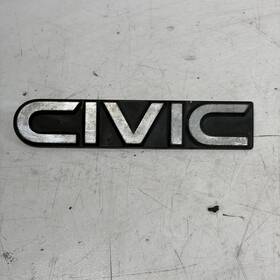
( Manufacturer Part Number: 87302-SB2-671 ), ( Type: Emblem ), ( Color: Silver ), ( Placement On Vehicle: Rear ), ( Suitable For: Car ), ( Country Of Origin: Japan )
Review HONDA Rear Emblem Oem fits CIVIC CRX 1984–1987
The **Honda 87302-SB2-671 (1984 1987 Civic CR-X Rear Emblem)** is a meticulously crafted, high-quality reproduction emblem designed to restore the authentic look and heritage of Honda s iconic CR-X model from the early 1980s. This emblem is a precise replica of the original chrome-plated badge that adorned the rear hatch of the CR-X, a compact, sporty hatchback celebrated for its sleek styling, aerodynamic silhouette, and cutting-edge technology of its era. Crafted from durable, polished chrome metal, the emblem features the distinctive Honda logo a stylized winged emblem flanked by the model designation "CR-X" in bold, clean lettering, all set against a crisp, reflective background. The design captures the minimalist yet bold aesthetic that defined the CR-X s identity, making it a sought-after accessory for enthusiasts and restorers aiming to achieve factory-correct authenticity. Whether installed on a restored 1984 1987 Civic CR-X or used as a decorative piece for a garage display, this emblem adds a touch of timeless elegance and mechanical precision, embodying the spirit of Honda s engineering excellence from the late 1980s. Its sturdy construction ensures longevity, while the polished finish guarantees a mirror-like sheen that complements the vehicle s overall appearance. Perfect for collectors, customizers, and purists who appreciate the finer details of classic automotive design, this emblem is more than just an aftermarket part it s a tribute to a legendary era of Japanese automotive innovation.
### Pros and Cons of Buying a 1984-1987 Honda Civic CRX (Part Number: 87302-SB2-671 Rear Emblem)
#### **Pros:**1. **Classic Design and Nostalgia** The CRX is a beloved icon from the 1980s, known for its sleek, aerodynamic styling and cultural significance. Owning one allows you to drive a piece of automotive history.
2. **Reliability and Durability** Honda s reputation for durability is well-earned, and the CRX s simple, efficient engine (the 1.5L or 1.6L DOHC) is known for lasting well with proper maintenance. Many original CRX engines still run strong after decades.
3. **Fuel Efficiency** The CRX was designed for economy, with the 1.5L engine achieving around 30-40 MPG in the 1980s. Even with modern fuel costs, this remains a practical choice for daily driving.
4. **Lightweight and Agile Handling** The CRX s small size and balanced weight make it highly maneuverable, making it ideal for city driving, parking, and spirited cruising.
5. **Aftermarket Support** The CRX has a strong following, with readily available parts, modifications (tuning, suspension upgrades, body kits), and a community of enthusiasts who share knowledge and upgrades.
6. **Low Operating Costs** Compared to modern cars, the CRX has minimal maintenance requirements (no complex electronics, fewer sensors, and simpler drivetrain components).
7. **Potential for Restoration or Modification** If you enjoy working on cars, the CRX is a great project vehicle. Restoring one to showroom condition or modifying it for performance can be a rewarding hobby.
8. **Affordability** While prices vary, a well-maintained 1984-1987 CRX is generally cheaper to purchase than newer cars, especially in lower trim levels.
---
#### **Cons:**1. **Age and Wear** Any car from this era will show signs of aging, including rust (especially in the frame, floor pans, and wheel wells), worn suspension, and potential electrical issues. A thorough inspection is critical.
2. **Rust Concerns** The CRX was not immune to rust, particularly in regions with harsh winters or salted roads. A pre-purchase inspection should check for structural rust, which can compromise safety.
3. **Electrical System Limitations** Older Hondas lack modern electronics, meaning fewer diagnostic tools, no OBD-II, and potential issues with wiring harnesses, fuses, or relays. Electrical problems can be harder to diagnose and repair.
4. **Limited Modern Safety Features** The CRX lacks modern safety standards like airbags (early models had none), ABS, or advanced driver-assistance systems. Safety recalls or upgrades may not apply.
5. **Parts Availability** While parts are widely available, some rare or discontinued components (e.g., specific body panels, interior trim) can be difficult or expensive to source.
6. **Driving Experience Differences** Modern cars offer superior comfort, noise insulation, and refined ride quality. The CRX s firm suspension and minimal sound deadening make for a less cushioned ride.
7. **Insurance Costs** Older cars may have higher insurance premiums due to perceived higher risk (e.g., theft, fire, or mechanical failure). Classic car insurance (agreed-value policies) can help mitigate this.
8. **Maintenance Knowledge Required** Without experience with older Hondas, you may need to invest time or money in learning how to service the car properly (e.g., valve adjustments, carburetor tuning, or manual transmission maintenance).
9. **Resale Value** While the CRX holds value well among enthusiasts, its resale value is not as strong as modern cars. If you plan to sell later, the depreciation may not be as favorable as a newer vehicle.
10. **Environmental Regulations** Some states or countries have emissions or safety standards that may require modifications (e.g., smog checks, retrofitting emissions systems) to register the car legally.
---
### **Conclusion:**Buying a 1984-1987 Honda Civic CRX is a fantastic choice if you prioritize **nostalgia, reliability, fuel efficiency, and a fun driving experience** especially if you re an enthusiast who enjoys working on or modifying cars. The CRX is a practical daily driver for those who appreciate its simplicity and charm, and its low cost of ownership makes it a budget-friendly alternative to modern vehicles.
However, if you value **modern safety, comfort, and convenience**, the CRX may fall short. It requires **diligent maintenance, rust checks, and possibly restoration work** to ensure it remains roadworthy. The car is best suited for:
- **Enthusiasts** who love classic cars and enjoy tinkering.
- **Budget-conscious buyers** who want a reliable, low-cost vehicle.
- **Urban drivers** who appreciate maneuverability and efficiency.
- **Project car owners** willing to invest time or money into bringing it back to peak condition.
For those who prefer **plug-and-play reliability, advanced safety, and minimal upkeep**, a modern used or new car would be a better fit.
---
### **Recommendation:** If you re considering this CRX, **prioritize a thorough inspection** by a trusted mechanic familiar with Hondas from this era. Look for:- **No major rust** (especially in critical areas like the frame and suspension).
- **A well-documented service history** (oil changes, timing belt, valve adjustments).
- **Functioning electrical components** (lights, gauges, ignition).
- **A smooth-running engine** (no excessive noise, leaks, or hesitation).
If you find a **clean, rust-free example with a reliable engine and transmission**, the CRX is an excellent purchase. If the car has **significant rust, electrical issues, or a neglected engine**, it may not be worth the hassle unless you re prepared to restore it as a long-term project.
For most buyers, the **1984-1987 CRX is a fantastic car to own if you love its character and aren t afraid of a little extra work**. If you re looking for a hassle-free, modern alternative, consider a well-maintained used Honda from the 2000s or later.
Details:
84-87 Honda Civic CRX Rear Emblem 87302-SB2-671 OEM, OEM.
part #: 87302sb2671 price
- $29.00
specifications emblico:
- for models: Crx, Civic
- for makes: Honda
- for years: 1984-1987
- mpn: 87302-sb2-671
- type: Emblem
- color: Silver
- placement on vehicle: Rear
- suitable for: Car
- country of origin: Japan
general emblico:
- condition: Used
- Car Truck Parts Accessories > Exterior Parts Accessories > Emblems Ornaments
shipping emblico:
- cost: $0.00
- transit: 3-8 Days
- class: Standard, Expedited
- service: USPS Ground Advantage, USPS Priority Mail, USPS Priority Mail Express
- carrier: USPS
- type: Calculated
seller emblico:
- city: Wilmington, California
- # reviews: 12656
- rating: 99.5%
payments emblico:
- other
- credit card: Visa
- wallet: Apple-pay
returns emblico:
- policy: Returns Accepted
- paid by: Buyer
- time: 30 Days
offer emblico:
- sold: 0
- started: February 17, 2026
- quantity: 1
- options: Ship-to-home
- availability: In Stock
Honda 87302-SB2-671 Is Similar To:
- 08700-9211 087009211 Genuine Factory American Honda Oem Car Care Kit Glass Leather (13.3% similar) Buy online and save big. Super fast delivery. Gulping honda wants to be sure you are getting the item want or need. 100 factory original oem part. Leather vinyl Protestant 4 oz. Glass cleaner 4 oz. Gulping honda does not sell or ship parts overseas...(August 10th, 2018)
- 08f20-s2a-10002 Honda Genuine Oem Black Chrome Emblem (34.6% similar) length brand new in the package. Genuine honda oem black chromes emblem. width made in japan. height plastic emblem with an adhesive backing...(March 2nd, 2018)
- 08f20-sjc-100 Honda Nos Oem Ridgeline (25% similar) The measures approximately across front and is high. Nos oem honda ridge line gold emblems new old stock genuine part in box. The 4WD emblem has adhesive on back to attach your vehicle. The ridge line emblem has adhesive on back to attach your vehicle. The 4WD emblem is gold and black in color. This...(March 19th, 2017)
- 08f20-ts9-100a Honda 2 Oem Factory Performance (22.7% similar) There is protective plastic over them emblems in the picture. I placed one under the sport badge and other in front of shiftier interior. You are purchasing 2 oem honda factory performance HF emblems. The first two pics are of emblems on my personal vehicle. These are a soft flexible emblem with ...(March 4th, 2017)
- 08f20-tx6-200 Honda Genuine Oem Acura Ilx Black Emblem (36.2% similar) Compatible with 2019 lix: 24PREM a-spec 24TECH only. Its bold features not only completes your ilks original unique exterior style, but also accentuates it. 2019 aura lix black EMBLEM08F20-TX6-200 if attention to detail is more important you then re sure love the look of chrome emblems. Stylish ...(October 26th, 2018)
- 08f20-tz3-200 Acura Honda Tlx Rear Emblem Black New (41.2% similar) Contact Leo with any questions. Why Naples speed...(October 20th, 2018)
- 09832 Honda 92-95 Civic Oem (46.2% similar) This is an extra I never used...(October 29th, 2017)
- 17126-rwc-a00 Honda Oem Acura Turbo Rsx Civic Si Greddy Rdx Engine (34.2% similar) It will come wrapped up in the oem honda packaging. It was actually found under the hood of DX, but you can use on any vehicle want. Genuine honda part. 5 long and about 2 wide. Peel the tape and stick. It has 3m tape on the back, so will easily mount to any car you choose...(September 15th, 2018)
- 2-em-honda-grille-a I-max Chrome Front Grille H Emblem (30.5% similar) Chrome front grille emblem for honda accord coupe 2 door fitment: 2DR. Emblem size: 123MM x 100MMCOME with 2 retainer clips replace for missing or INSTALL100 new and never used package included:front emblem x1 100MM please measuring the original front emblems on your vehicle before purchasing...(February 25th, 2018)
- 2-em-honda-grille-c New Chrome Front Grille Emblem For Honda Accord Crv Fit (28.6% similar) New chrome front grille emblem for honda accord CV fit HR hr-v fitment: sedan COUPE2010-2011 CRV2015-2017 FIT2015-2017 : emblem size: 123MM x 100MMCOME with 2 retainer clips replace missing or damaged emblem easy INSTALL100 and never used package included:front x1 100MM please measuring the original...(March 1st, 2018)
- 2-em-honda-sl-a New Front Grill Emblem For Honda Crv Fit Hrv Speed (30.8% similar) 3 scratches picture shown. 2 on top left and one the right...(September 11th, 2018)